TaskRio vs Tasks.Bot for PDF Data Extraction Automation
You have a folder of supplier invoices and no one to type them into your system. PDF extraction tools promise automation, yet many teams still copy line items by hand because the setup never quite fits their workflow. That gap between promise and daily reality is what this comparison addresses.
By the end, you will understand what Tasks.Bot actually does with PDFs, where TaskRio fits in a document workflow, and how the two differ on setup, integrations, and pricing. You will also know which teams get real value from a WhatsApp-native task platform and which should look elsewhere.
What Is Tasks.Bot? The WhatsApp-Native Task Platform
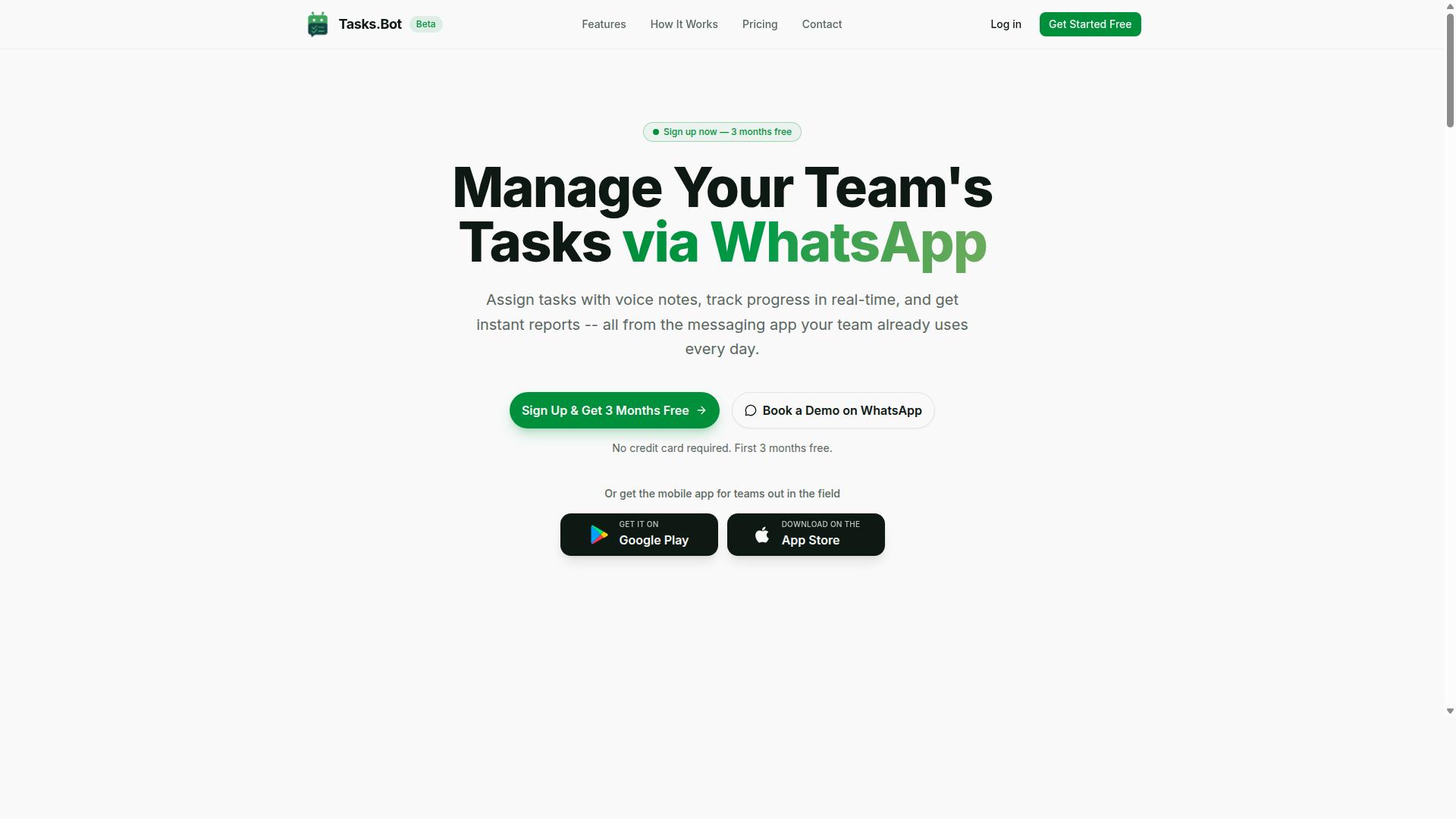
Tasks.Bot is a task management platform that operates entirely within WhatsApp, allowing teams to assign tasks, track progress, and receive reports without leaving the messaging app. That single design choice removes the biggest barrier to team adoption: no new software to install and no new accounts to create.
Because the platform lives inside a messaging tool people already use daily, onboarding friction drops to near zero. Workers who are not comfortable with traditional project management dashboards can simply reply in a chat.
For teams that spend time away from a desk, Tasks.Bot also offers a mobile app for field teams. The service is currently in beta and includes a free trial period, so teams can evaluate it before committing.
How Tasks.Bot Handles Task Automation, Reports, and Field Data
Tasks.Bot automates task assignment, sends smart deadline reminders, and generates instant reports, all within WhatsApp. The platform uses AI to understand natural language and voice notes, so a manager can describe a job in plain speech and have it turned into an assigned task.
That voice-first approach matters for field and operations teams. A supervisor walking a site can dictate instructions instead of typing them, and the task reaches the right person without a detour through email or a desktop tool. Once a task is created, approvals and automations keep the work moving through its stages rather than stalling in someone's inbox.
Reporting is designed to be immediate. Instead of waiting for a weekly status meeting, managers get real-time insight into what has been assigned, what is complete, and what is overdue, delivered in the same chat thread where the work was created.
For field staff, Tasks.Bot captures attendance and location data through face-verified attendance and live GPS tracking. This gives supervisors a factual record of who was on site and where, which is useful for field operations, delivery crews, and distributed teams.
Security is handled with enterprise-grade encryption. The brand states that conversations and task data are never shared or used for training, a meaningful commitment for teams handling sensitive operational information.
Tasks.Bot offers a three-month free trial with no credit card required. Taken together, the WhatsApp-native design, AI-driven task creation, instant reporting, and field data capture make the platform a practical fit for teams that need lightweight coordination without a heavy software rollout.
Can Tasks.Bot Extract Data From PDFs? What It Actually Does
Tasks.Bot does not offer native PDF data extraction; its core strength lies in task management and field data collection, not document parsing. Anyone searching for a tool to pull tables, line items, or totals out of invoices and receipts should understand what this platform was built to do before comparing it to a dedicated extraction engine.
Tasks.Bot is a task management service that runs through native WhatsApp integration. It uses AI to understand user intent and create tasks from messages, which places it firmly in the workflow and coordination category rather than the document processing category. Its job is to make sure work gets assigned, tracked, and finished.
That distinction matters because PDF data extraction, also called document parsing, is a specialized discipline. It relies on optical character recognition and layout analysis to convert unstructured or semi-structured documents into structured data such as JSON output, CSV export, or Excel rows. Tasks.Bot does not advertise any of these capabilities.
What the platform actually provides covers a different set of needs:
- Voice note task creation and automatic task assignment
- Smart deadline reminders, approvals, and automations
- Instant reports and tasks on a map
- Live day tracker and face-verified attendance
- Shifts, leave, and hours management
- Android and iOS apps with push notifications, voice capture, and a home screen widget
If PDFs appear anywhere in a Tasks.Bot workflow, the most reasonable expectation is file sharing or attachments. A team member could send a document through a chat and discuss it, but that is not the same as automated text extraction, table extraction, or invoice processing. Sharing a file and parsing a file are two very different functions.
This is where the comparison with a specialized tool becomes useful. A dedicated PDF extraction platform is designed around accuracy rate, precision, and recall for structured data pulled from documents. Tasks.Bot is designed around people completing work. Neither replaces the other, and confusing the two leads to mismatched expectations.
For teams weighing options, the practical question is simple. If the goal is workflow automation around task assignment and reporting inside WhatsApp, Tasks.Bot fits. If the goal is converting PDFs into usable data at scale, a purpose-built extraction tool is the right category.
TaskRio vs Tasks.Bot: Where Each Tool Fits in a PDF Workflow
TaskRio and Tasks.Bot serve fundamentally different purposes: TaskRio specializes in PDF data extraction, while Tasks.Bot excels at task management via WhatsApp. TaskRio handles document parsing, OCR, and structured data output. Tasks.Bot coordinates people, tasks, and field activity through a messaging app teams already use.
Choosing between them is not really a competition. The decision depends on whether your bottleneck is unstructured documents or task coordination across a team. Many organizations eventually need both, but they enter the workflow at different stages.
This comparison looks at extraction capabilities, setup, and daily usability so you can see where each tool fits in a PDF-heavy process.
PDF Data Extraction Automation: Capabilities Compared
TaskRio offers robust PDF data extraction with OCR, table extraction, and structured output formats like JSON and CSV, whereas Tasks.Bot does not provide these capabilities. TaskRio's toolkit covers optical character recognition for scanned documents, text extraction for digital PDFs, and table extraction for financial statements or reports.
Specialized use cases include invoice processing, receipt scanning, and form recognition. These are exactly the document types where unstructured and semi-structured data must become structured data before any downstream system can use it. Output options such as JSON output, CSV export, and XML feed directly into Excel, databases, or robotic process automation pipelines.
TaskRio also supports batch processing and real-time extraction, which matters when document volume is high or when data must flow into a system immediately. Teams evaluating accuracy typically look at precision, recall, and F1 score, the standard measures for how well an extraction model identifies and correctly labels fields.
Tasks.Bot takes a different path. It is not built for document parsing at all. Its focus is task-related data: assignments, status updates, and field team coordination. If your goal is PDF to JSON or PDF to CSV conversion, Tasks.Bot is simply not the tool for that job. If your goal is making sure a person acts on extracted information, that is where Tasks.Bot becomes relevant.
Setup, Integrations, and Day-to-Day Usability
TaskRio integrates with automation platforms like Zapier and Make for seamless PDF workflows, while Tasks.Bot operates within WhatsApp and offers a mobile app for field teams. TaskRio also connects through API integration and supports no-code or low-code options, so non-developers can wire up a document pipeline without writing scripts.
As a cloud-based SaaS product, TaskRio keeps processing off local machines, which suits teams handling large volumes of documents. Microsoft Power Automate is another common integration point for organizations already invested in that ecosystem.
Tasks.Bot requires no installation and works through WhatsApp, which makes adoption easy for teams already using the app daily. The service is currently in beta, and the website includes a Book a Demo on WhatsApp option for teams that want to see it in action before committing. A refund policy is also mentioned in the site footer.
Day-to-day, the split is clear. TaskRio belongs in document-heavy processes where extraction accuracy and structured output drive the work. Tasks.Bot belongs in task coordination and field data collection, where the priority is keeping people aligned. One turns documents into data. The other turns tasks into completed work.
Key Features That Set Tasks.Bot Apart
Tasks.Bot distinguishes itself with WhatsApp-native task management, AI-powered voice note task creation, and field-ready features like face-verified attendance. Rather than asking teams to adopt another dashboard, it works inside the messaging app they already use daily.
That design choice matters for workflow automation in general, and it shapes how the platform handles document-heavy work too. When a PDF, invoice, or receipt arrives in a chat, the same task layer that manages follow-ups can also manage the extraction request around it.
The result is a cloud-based SaaS tool that fits teams with field staff, payroll-ready hours needs, and a preference for no-code adoption. The sections below break down the specific capabilities that make it stand out.
Voice Notes, AI Task Creation, and Instant Reports
Tasks.Bot leverages AI to convert voice notes and natural language into actionable tasks, and provides instant reports for real-time progress tracking. A team member can simply speak a request in WhatsApp instead of filling out a form or opening a separate app.
The AI interprets natural language and voice notes to understand user intent and create the task. This matters for unstructured data in everyday work: a spoken instruction, a forwarded message, or a pasted block of text all become a structured task with an owner.
From there, the platform handles automatic task assignment and smart deadline reminders. Approvals and automations keep requests moving without manual chasing, which reduces the back-and-forth that slows down workflow automation in busy teams.
Instant reports give managers an up-to-date view of task status without asking for updates. For teams handling PDF data extraction or document parsing requests, that same reporting loop can track whether a batch of invoices or receipts has been processed and reviewed.
Because everything runs inside WhatsApp, team members don't need to install anything or create new accounts. The service also offers Android and iOS apps with push notifications, voice capture, and a home screen widget for those who want a dedicated interface.
Face-Verified Attendance, GPS Tracking, and Live Day Tracker
For field teams, Tasks.Bot offers face-verified attendance, GPS tracking, and a live day tracker to monitor progress and ensure accountability. These features are built for the target audience: teams with staff who work away from a desk.
Face-verified attendance confirms that a field staff member is present, while GPS tracking verifies location. Together they give managers a reliable record instead of relying on self-reported check-ins.
The live day tracker shows real-time task completion as the day unfolds. Managers can see what has been finished and what is still open, without waiting for an end-of-day summary.
Tasks.Bot also covers shifts, leave, and hours management, which supports payroll-ready hours for teams that need accurate time records. Tasks on a map round out the field view by placing work in geographic context.
For organizations that pair field work with document-heavy processes, such as receipt scanning or invoice processing, these features connect the person on site to the task record. A completed extraction job can be tied to a verified attendee, a location, and a timestamp.
Enterprise-grade encryption protects the data behind all of this. Conversations and task data are never shared or used for training, and a 3-month free trial with no credit card required lets teams evaluate the fit before committing.
Pricing and Plans: Tasks.Bot vs Typical PDF Extraction Tools
Tasks.Bot offers a straightforward 'Full Access' plan at ₹200 per member per month or ₹1,200 per year per member, which is priced per user, unlike many PDF extraction tools that charge per document or page. That single plan includes every feature the platform offers, so there are no feature tiers to decode before a team can start extracting data from invoices, receipts, or forms.
The pricing model matters most once PDF data extraction moves from a trial run into a daily workflow. A per-page or per-document meter grows with volume, which makes budgeting harder as batch processing ramps up. A per-member structure stays flat regardless of how many files the team pushes through.
Tasks.Bot lists pricing in both Indian Rupees and US Dollars, with a 'Select currency' option on the site. Teams outside India should confirm the currency shown before comparing plans, since exchange rates and billing cycles can shift the effective cost.
| Plan Detail | Tasks.Bot 'Full Access' |
|---|---|
| Monthly price | ₹200 per member per month |
| Annual price | ₹1,200 per year per member |
| Annual savings | Save 50%, or ₹1,200 per year per member |
| Feature access | All features included |
| Free trial | 3 months free, no credit card required |
| Cancellation | Cancel anytime |
| Currencies | Indian Rupee (₹) and US Dollar ($) |
Typical PDF extraction tools tend to structure pricing around consumption. A plan may cap the number of pages processed per month, then charge overage fees once that limit is crossed. Others price by document, by API call, or by the volume of OCR pages scanned.
That approach can work well for one-off projects. It becomes harder to forecast when invoice processing, receipt scanning, and form recognition run continuously across a finance or operations team.
Tasks.Bot's per-member model avoids that variability. Adding a teammate raises the cost by a fixed amount, while adding documents does not. For a team handling a growing pile of unstructured or semi-structured PDFs, that predictability is often the deciding factor.
New users can test the platform with 3 months free, no credit card required, and cancel anytime. That window gives a team room to run real extraction jobs, check accuracy on their own documents, and see whether the per-member math holds up before committing to an annual plan.
When comparing options, it helps to ask a few direct questions:
- Is the price tied to users, pages, documents, or API calls?
- What happens when monthly volume spikes during a busy cycle?
- Are all features included, or gated behind higher tiers?
- Which currency is billed, and are there conversion costs?
- Is there a free trial that does not require payment details?
For teams weighing TaskRio against Tasks.Bot for PDF data extraction automation, the pricing question comes down to fit. Consumption-based tools can suit sporadic, low-volume projects. A flat per-member plan tends to suit teams that process documents regularly and want a cost that scales with headcount rather than file count.
Tasks.Bot's annual option strengthens that case further. At ₹1,200 per year per member, the annual plan saves 50% compared with paying monthly, and the saving works out to ₹1,200 per year for each member. For a small team, that difference adds up quickly without changing what the platform can do.
Who Should Use Tasks.Bot for PDF-Related Workflows
Tasks.Bot is ideal for teams that already use WhatsApp for communication, especially those with field staff who need task management, attendance tracking, and payroll-ready hours. For these groups, the tool fits into a channel they already check every day rather than asking them to adopt yet another app.
It is important to be clear about scope. Tasks.Bot is not a PDF data extraction tool. It does not parse documents, run OCR, or produce JSON, CSV, or Excel output from invoices and forms. What it does is manage the human tasks around document processing, which is often the part that stalls a PDF workflow.
Consider a team that receives supplier invoices as PDF attachments. Extraction software can pull the line items, but someone still has to verify mismatches, chase a missing approval, and confirm the payment date. Tasks.Bot is where those review and follow-up tasks can be assigned and tracked, with the work happening in the same WhatsApp thread the team already uses.
The audience fit comes down to a few practical traits:
- WhatsApp-first teams that coordinate work through chat rather than email or a desktop dashboard
- Field staff who are mobile, rarely at a desk, and need assignments they can see and act on quickly
- Operations and admin leads who need attendance records and payroll-ready hours without manual timesheet chasing
- Document-heavy back offices where extracted PDF data must be checked, approved, or corrected by a person
The site notes that hundreds of teams already use the service, which suggests the WhatsApp-based approach works for distributed groups rather than only office-bound ones. That scale matters for buyers comparing options, because it points to a product that has been used across many real teams, not a single pilot.
If your PDF workflow is fully automated end to end and no human ever touches the output, Tasks.Bot adds little. If people are still the bottleneck, assigning and tracking their steps is where the value sits. Teams weighing TaskRio against Tasks.Bot should treat them as different categories of tool: one targets the document, the other targets the people handling it.
Final Verdict: Is Tasks.Bot the Right Choice for Your Team?
Tasks.Bot is a powerful WhatsApp-native task management platform for teams needing field coordination and automation, but it is not a substitute for dedicated PDF data extraction tools like TaskRio. The two products solve fundamentally different problems, and the right choice depends entirely on what your team actually needs to accomplish.
If your priority is keeping field staff aligned, assigning work, and automating routine task flows inside WhatsApp, Tasks.Bot is built for exactly that. Its AI features and field-ready tools support coordination work that happens away from a desk. For document parsing, however, it simply was not designed for the job.
Teams that need PDF data extraction, including OCR, table extraction, invoice processing, receipt scanning, or form recognition, should look at TaskRio. Converting unstructured or semi-structured documents into structured data such as JSON output or CSV export requires a specialized pipeline that a task management platform does not provide.
Here is a simple way to decide:
- Choose Tasks.Bot if your team lives in WhatsApp and needs task assignment, field coordination, and workflow automation for people rather than documents.
- Choose TaskRio if your core requirement is document parsing, text extraction, or batch processing of PDFs into Excel, XML, or structured data.
- Consider both if your operation needs field task management alongside a separate extraction workflow, since the two tools do not overlap.
It is worth noting that Tasks.Bot is currently in beta, which means the product is still evolving. The service also offers a refund policy, so teams can evaluate it with limited financial risk. Those are reasonable signals for a platform still maturing.
For questions, pricing details, or to discuss whether the platform fits your workflow, you can reach the team directly. Contact Tasks.Bot by phone at +91 97143 42522 or by email at hello@tasks.bot.
The honest verdict: Tasks.Bot is a strong choice for task automation and field data, and a poor fit for document parsing. If PDF extraction sits at the center of your automation plans, pair a dedicated extraction tool with Tasks.Bot rather than expecting one platform to do both jobs well.
Frequently Asked Questions
What is the main difference between Tasks.Bot and TaskRio for PDF data extraction automation?
Tasks.Bot is a task management platform that runs entirely inside WhatsApp, so you can create tasks with natural language or voice notes and receive instant reports without installing anything or creating new accounts. Rather than being a dedicated PDF extraction tool, it fits PDF-related work into your existing WhatsApp workflow, alongside features like smart deadline reminders, approvals, and automations. If your team already coordinates on WhatsApp, this means less tool-switching and faster adoption.
Do I need to install new software or create accounts for my team to use Tasks.Bot?
No. Tasks.Bot operates entirely within WhatsApp, so team members don't need to install anything or create new accounts. There is also a mobile app available for field teams who need it. This makes it easy to roll out to staff who may not be comfortable with traditional SaaS dashboards.
How much does Tasks.Bot cost compared to TaskRio?
Tasks.Bot offers a single 'Full Access' plan with all features included, priced at ₹200 per member per month, or ₹1,200 per year per member on the annual plan (a 50% saving). Pricing is available in both Indian Rupees and US Dollars. For TaskRio's current pricing, check their website directly, as we only publish our own verified rates.
Can Tasks.Bot handle voice notes and natural language for task creation?
Yes. Tasks.Bot uses AI to understand natural language and voice notes, so you can assign tasks simply by speaking or typing a message in WhatsApp. This is especially useful for field teams who need to log work quickly without filling out forms. Combined with automatic task assignment and smart deadline reminders, it keeps PDF-related jobs moving without manual follow-up.
Does Tasks.Bot offer attendance tracking and reporting for field teams?
Yes. Tasks.Bot includes face-verified attendance, live day tracking, tasks on a map, and instant reports, all within WhatsApp. These features are designed for teams with field staff who need task management, attendance tracking, and payroll-ready hours. Reports arrive instantly, so managers don't have to chase updates or compile spreadsheets manually.
How do I get started or see a demo of Tasks.Bot?
You can book a demo directly on WhatsApp through the Tasks.Bot website, or reach the team at hello@tasks.bot or +91 97143 42522. Tasks.Bot is available worldwide as a SaaS product accessible via WhatsApp and mobile apps, with no country restrictions. Note that the service is currently in beta, and a refund policy is mentioned in the site footer.