Is Autoblogging.ai Good for Research Driven Writing
Most research driven writers spend hours gathering sources before typing a word. That time is the real bottleneck, not the writing itself. If you are weighing Autoblogging.ai for citation heavy drafts, the research layer is what matters.
This article explains how Autoblogging.ai handles SERP analysis and knowledge graph extraction, what Godlike mode actually pulls, and where human proofreading still fits. You will finish knowing which research heavy workloads it suits and where it falls short.
What Is Autoblogging.ai?
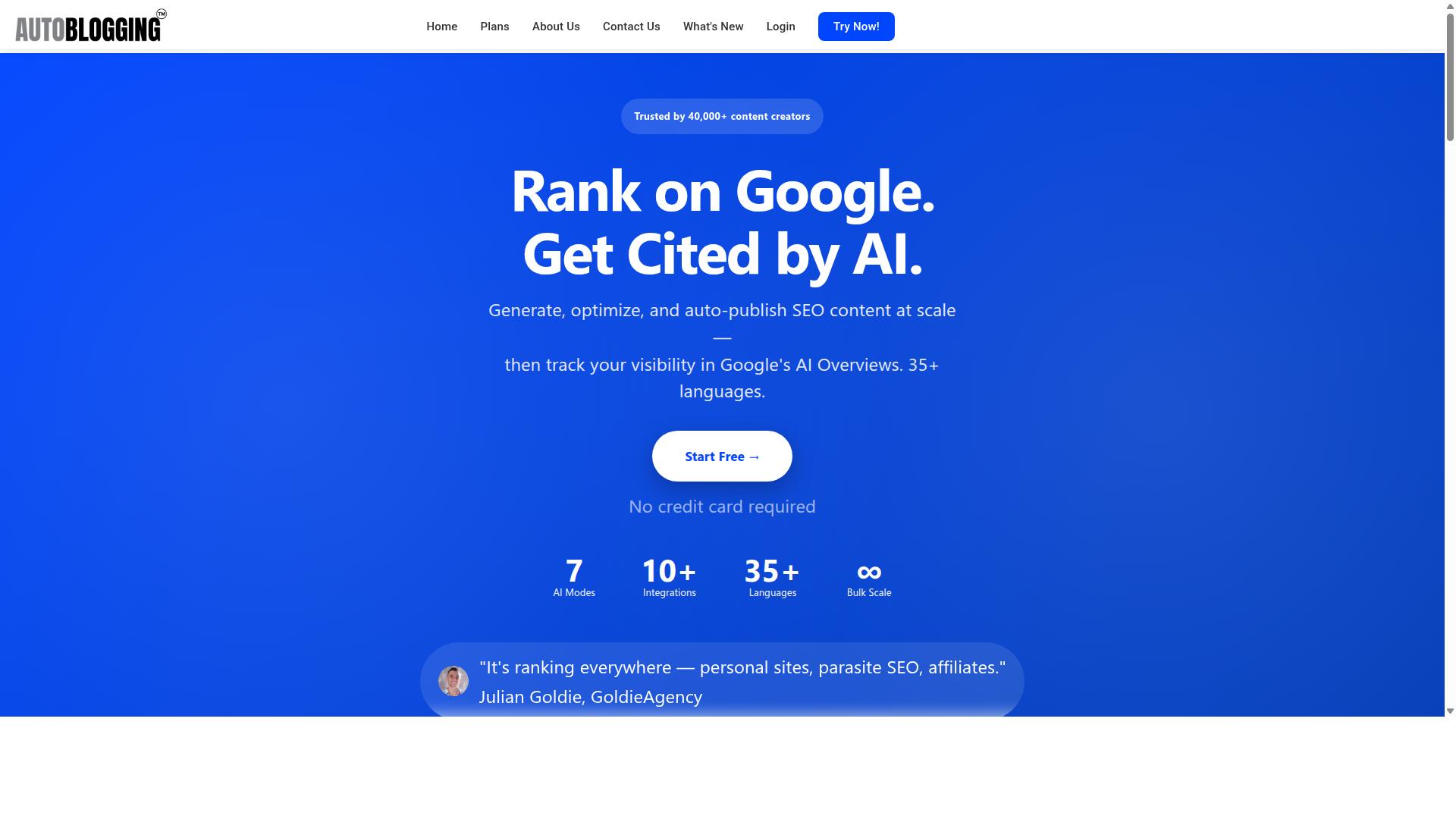
Autoblogging.ai is a cloud-based AI article generation platform that transforms keywords into complete, publish-ready blog posts using multiple generation modes. It is a product of Digimetriq.com, built with a clear mission: help bloggers, website owners, and agencies save time and improve their online presence through cutting-edge technology.
Founded in 2022 by Vaibhav Sharda, the platform has since generated over 1 million articles for more than 40,000 content creators. Its stated aim is to cut content costs and give the power to human counterparts within standard operating procedures by delivering a strong first draft, a detail that matters when weighing how the tool fits into research-driven writing workflows.
Who It's Built For: Bloggers, Agencies, and SEO Professionals
Autoblogging.ai serves a diverse range of users, from solo bloggers to large marketing agencies, each with distinct content needs. The platform is designed for bloggers, website owners, SEO professionals, marketing agencies, content creators, and affiliate marketers.
For bloggers, the main benefit is speed. Instead of staring at a blank page, they can turn a keyword into a structured draft and spend their time refining arguments and checking facts. For agencies, the value is scale. Producing content for multiple clients at once becomes a workflow question rather than a hiring question, which keeps projects moving without expanding headcount.
SEO professionals often use the tool across several site types. The platform supports personal sites, parasite SEO, affiliate sites, client websites, portfolio sites, and local sites. That range matters because each site type demands a different content rhythm, from quick affiliate reviews to ongoing topical coverage on a portfolio of domains.
A practical example: a niche site network owner might need 500 articles per month across dozens of domains. Generating that volume by hand is rarely realistic, but an AI content generator built for automated blogging makes the workload manageable while the owner focuses on strategy, data verification, and quality control.
Affiliate marketers benefit in a similar way. They can build out product-focused content across many keywords, then apply human review to strengthen factual accuracy before publishing. The platform does not replace the marketer's judgment, but it removes the slowest part of the process: producing the first draft.
Is Autoblogging.ai Good for Research Driven Writing? The Direct Answer
Yes, Autoblogging.ai is effective for research-driven writing, but it requires a human-in-the-loop approach to ensure factual accuracy and proper source citation. It works best as a research accelerator, not as a finished authority on any subject.
The platform is an AI content generator built for automated blogging and SEO output. That makes it a strong fit for the early, messy stages of a project: gathering background, mapping a topic, and producing a first draft you can refine.
Where it genuinely helps is speed. A 2,000-word article structured around LSI keywords can be drafted quickly. That gives you a scaffold to edit rather than a blank page to fill.
Its deeper mode goes further. According to the brand, Godlike Mode analyzes SERP competitors and extracts knowledge graphs, which means the draft is shaped by what already ranks and what related entities matter. For competitive analysis and trend analysis, that is useful orientation before you dig into primary sources.
But the limits matter just as much. AI models can hallucinate: inventing a plausible statistic, misattributing a quote, or citing a source that does not exist. They also tend to miss nuance that lives in peer-reviewed journals, white papers, and technical reports.
So treat the output as a starting point, not a finished argument. Use it for first drafts, data gathering, and outlining. Then verify every fact, confirm each source citation, and add references manually before anything goes live.
- Good for: outlining, background scans, literature review scaffolding, LSI keyword coverage, first drafts
- Weak for: verified statistics, direct quotes, precise attribution, contested or fast-moving findings
- Required: data verification, plagiarism checks, citation management, and reference formatting by a human
It is not a replacement for scholarly research. It cannot read a full paper the way a subject specialist does, and it will not catch a subtle methodological flaw. What it can do is compress the boring parts: the scanning, the structuring, the first pass at thesis development and argumentation.
For evidence-based content, the workflow that holds up is simple. Let the tool draft and organize, then apply critical thinking yourself: check claims against primary sources, weigh secondary sources, and confirm that each number traces back to something real.
Used that way, Autoblogging.ai is a legitimate research companion. It accelerates literature reviews and evidence-based writing while leaving judgment, verification, and accountability exactly where they belong: with you.
How Autoblogging.ai Handles Research: Godlike Mode and SERP Analysis
Godlike Mode is Autoblogging.ai's most advanced research feature, performing SERP competitor analysis to extract LSI keywords and knowledge graph entities.
Instead of asking a writer to guess what Google rewards, it studies the top 10 results for the target keyword. From those pages it identifies recurring headings, the questions searchers are asking, and the semantic keywords that tie a topic together.
That picture of the SERP helps researchers see which primary and secondary sources top pages lean on. It suits competitive analysis, market research, and trend analysis, where knowing the shape of the conversation matters as much as the writing itself.
Knowledge Graph Extraction, LSI Keywords, and Semantic SEO
Godlike Mode extracts entities from Google's Knowledge Graph and integrates LSI keywords to produce semantically rich content that aligns with search intent.
Knowledge graph extraction maps the people, places, organizations, and concepts tied to a topic, along with how they relate. That matters for research-driven writing, because an article built around real entities covers a subject the way an informed reader expects, not as an isolated keyword.
LSI keywords come from analyzing the pages already ranking, surfacing the related terms those pages share. For a keyword like quantitative data analysis, the mode might pull entities such as statistical significance and regression models, alongside LSI keywords like data visualization and hypothesis testing.
- Entities: named people, places, and concepts from the Knowledge Graph
- LSI keywords: related terms drawn from top-ranking pages
- Semantic coverage: a topic treated in full rather than around one phrase
This supports semantic SEO by building depth instead of repetition. Writers get a map of what to cover and how the pieces connect, which reduces keyword stuffing and keeps the focus on meaning.
For research-driven work, the payoff is a clearer view of the field before drafting begins. The same entity and keyword data feeds other Autoblogging.ai tools, including Semantic SEO Analysis with its 21-point audit, Topical Maps, and Fan Out Queries, so research findings carry through the rest of the workflow.
Beyond the First Draft: Human Proofreading and Editing Workflow
Autoblogging.ai generates a solid first draft, but human proofreading is essential to verify facts, add citations, and refine arguments for research-driven writing. The platform is built to speed up the drafting stage, not to replace the judgment of a researcher. Treat its output as raw material that still needs your expertise.
One feature worth knowing is Godlike Mode, one of the 10+ AI modes available on the platform. It is designed for longer, more detailed output, which makes it a reasonable starting point for research-driven writing. From there, the real work begins.
Every fact, figure, and claim in the draft needs to be checked against primary sources before it goes anywhere near a final document. AI models can hallucinate, producing confident statements that sound correct but have no basis in reality. Verification is not optional in academic writing or technical reports.
Here is a workflow that keeps automated blogging useful without sacrificing content quality:
- Generate the draft. Use Godlike Mode to produce a structured first version of your section or article.
- Fact-check every statistic and claim. Trace each number back to a primary source such as a peer-reviewed journal, government dataset, or official report.
- Add proper citations. Format references in the style your audience expects, whether APA, MLA, Chicago, or another standard.
- Improve logical flow and argumentation. Strengthen thesis development, connect evidence to claims, and remove weak transitions.
- Run plagiarism checks. Confirm the text is original and that quoted material is properly attributed.
Autoblogging.ai includes a human proofreader in all plans, which adds a layer of review beyond automated checks. For citation management and reference formatting, dedicated reference tools can complement that service. For grammar and style, tools like Grammarly are widely used, and Copyscape is a common choice for plagiarism screening.
Use this checklist when editing academic or technical content:
- Are all statistical data points traced to primary sources?
- Are secondary sources clearly distinguished from primary ones?
- Do citations follow the required reference formatting style?
- Is the central thesis supported by the evidence presented?
- Are qualitative data and quantitative data interpreted accurately?
- Has the draft passed a plagiarism check?
- Does the argument reflect genuine critical thinking rather than summary?
AI-assisted drafting works best when paired with disciplined human review. The platform's role is to accelerate the early stages of writing, while factual accuracy and evidence-based reasoning remain your responsibility. That division of labor is what makes automated blogging viable for scholarly research and technical reports.
Other Research-Friendly Modes: News Mode, Bulk Generation, and Amazon Reviews
Beyond Godlike Mode, Autoblogging.ai offers News Mode for timely trend analysis, Bulk Generation for scaling research across multiple topics, and Amazon Reviews for product-based content. Each mode targets a different research need, so writers can pick the one that fits the task at hand.
For research-driven writing, this variety matters. A literature review, a market research brief, and a competitive analysis all demand different inputs. Autoblogging.ai structures its modes around those differences rather than forcing one workflow onto every project.
What follows is a plain look at what each mode does, where it fits in a research process, and how to use it without overstating what any AI content generator can deliver.
News Mode connects to Google News to surface recent coverage, which makes it a natural fit for trend analysis and current events writing. When a topic shifts week to week, a research workflow built on older sources quickly goes stale. News Mode gives writers a starting point grounded in what is being published now.
That timeliness has limits worth understanding. News coverage moves fast and sometimes corrects itself, so any claim pulled from a recent article should be checked against the original source before it appears in your draft. News Mode is best treated as a discovery layer, not a final authority.
- Use it to map how a topic is being framed in current coverage
- Use it to spot emerging angles before they appear in scholarly research
- Use it to date-stamp your own analysis against the news cycle
For a university communications team tracking public discourse, or a market research analyst watching a sector, News Mode shortens the gap between an event and a usable draft. The verification step still belongs to the writer.
Bulk Generation supports up to 500 articles at once through CSV input. That scale changes what is practical. Tasks that were once too repetitive to justify, such as building a broad set of topic briefs or covering many related keywords, become feasible in a single pass.
Consider a university website that needs 50 articles on qualitative data analysis methods. Rather than drafting each one by hand, a researcher could supply the keyword list and let Bulk Generation produce a first layer of material. Those drafts then serve as scaffolding: the writer adds primary sources, tightens the argumentation, and checks every claim.
The same approach works for a literature review spread across many subtopics. A reviewer might generate a set of articles covering different methods, theories, or case studies, then consolidate them into one coherent narrative with proper citation management.
- Scale topic coverage without scaling hours one-to-one
- Build a consistent structure across a large keyword set
- Produce first drafts that a human editor refines for factual accuracy
The key discipline is treating Bulk Generation as a starting point. Volume is useful only when every output is reviewed for source citation, plagiarism risk, and hallucination before it reaches a reader.
Amazon Reviews Mode extracts product data and customer feedback, which makes it useful for market research and competitive analysis. Instead of guessing what buyers care about, a researcher can work from patterns in actual reviews.
That is valuable for evidence-based writing about consumer behavior, product categories, or shifting preferences. A competitive analysis, for example, can draw on recurring themes in feedback rather than assumptions. A white paper on a product segment can cite observable sentiment.
Two cautions apply. Review data reflects a self-selected group of buyers, not a representative sample. And reviews can be biased, incentivized, or simply wrong. Treat the output as a signal to investigate, not a conclusion to publish.
| Mode | Best For | Research Use |
|---|---|---|
| News Mode | Current events and timely topics | Trend analysis, framing current coverage |
| Bulk Generation | Large keyword sets, up to 500 articles | Literature reviews, broad topic coverage |
| Amazon Reviews | Product and customer feedback | Market research, competitive analysis |
Taken together, these three modes give Autoblogging.ai a wider research footprint than a single-purpose AI content generator. News Mode handles the present, Bulk Generation handles scale, and Amazon Reviews handles the consumer angle. Used with a verification step, each one supports research-driven writing rather than replacing the judgment behind it.
Pricing and Plans for Research-Heavy Workloads
Autoblogging.ai offers tiered monthly and annual plans, with credit-based pricing that scales for research-heavy workloads requiring hundreds of articles. The structure is straightforward: you buy credits, you spend them on generation, and you move up a tier when your output demands it. For anyone producing content backed by literature reviews, market research, or technical reports, the question is not whether the entry plan works. It is which tier keeps pace with sustained output.
Every plan includes credits rollover, which means unused credits do not expire. That single detail matters for research-driven writing, where production is rarely steady. A quiet month does not wipe out capacity you already paid for.
| Plan | Monthly Price | Credits | Annual Price |
|---|---|---|---|
| Starter | $19 | 40 credits | $12/mo ($148/year) |
| Regular | $49 | 120 credits | $32/mo ($382/year) |
| Standard | $99 | 300 credits | $64/mo ($772/year) |
| Gold | $179 | 600 credits | $116/mo ($1,396/year) |
| Premium | $249 | 1,000 credits | $162/mo ($1,942/year) |
| Enterprise | $999 | 5,000 credits | $649/mo ($7,792/year) |
Annual billing brings the effective monthly cost down across every tier. Enterprise drops from $999 to $649 per month when billed yearly, and even Starter falls from $19 to $12. For teams committed to automated blogging at volume, the yearly option is the more economical route.
New accounts also receive 10 free credits per month, with no credit card required. That is enough to evaluate output quality before committing to a paid tier, and additional credits can be purchased if a project spikes beyond your plan.
For research-heavy workloads, Premium at $249 (1,000 credits) or Enterprise at $999 (5,000 credits) are the practical choices. Both support bulk generation and heavier use of Godlike Mode, which consumes more credits per article because it does more work per piece. Enterprise is built for operations running hundreds of articles monthly, where a single tier change removes the need to top up mid-project.
Cost per article is easy to estimate. On Enterprise, $999 for 5,000 credits works out to roughly $0.20 per credit. If one Godlike article consumes 10 to 20 credits, that places a single piece somewhere between $2 and $4 depending on length and depth. Compare that against the hours a writer spends gathering sources and drafting, and the math favors the credit model for high-volume research output.
Annual plans offer discounts on every tier, and Enterprise annual billing can be handled through bank transfers via Stripe for larger organizations. Standard payment methods include Visa, MasterCard, American Express, and PayPal. You can cancel anytime.
For teams that would rather not manage credits at all, Done For You packages are available: Starter at $1,200 for 1,000 articles, Pro at $1,600 for 1,000 articles, Corp at $4,000 for 1,000 articles, and Senpai at $10,000 for 1,000 articles. These suit research operations that want output delivered rather than generated in-house.
The verdict for research-driven writing is clear. Credit rollover protects your budget, Godlike Mode handles the depth that evidence-based content requires, and Premium or Enterprise keep pace with bulk demand. Autoblogging.ai is a sound fit for research-heavy workloads, and the pricing scales without punishing you for slow months.
Trust Signals: 40,000+ Users, 1M+ Articles, and Expert Testimonials
Autoblogging.ai has generated over 1 million articles for more than 40,000 content creators, earning a 4.9 average rating and endorsements from industry experts. Those numbers matter for research-driven writing because they reflect a track record built across a large, diverse user base rather than a handful of early adopters.
For anyone weighing an AI content generator against the demands of evidence-based work, scale and consistency are reasonable proxies for reliability. A platform that has supported thousands of automated blogging workflows has been exposed to a wide range of topics, formats, and quality expectations.
The platform also offers 10+ AI modes, support for 35+ languages, and 35+ integrations, alongside credits rollover, 24/7 support, and weekly feature updates. For researchers juggling multiple projects, credits that carry over and frequent updates suggest a tool that adapts rather than stagnates.
Expert testimonials add another layer of reassurance. Julian Goldie of GoldieAgency, whose YouTube channel has 250k+ subscribers, has endorsed the platform. James Dooley of FatRank and PromoSEO, Bart Magera of MojoLinks, Kyle Duncan, an SEO professional, and Dimitar Georgiev, CEO of IDEAMAX.EU, have also shared positive feedback.
Additional endorsements come from Cagri Sarigoz, founder of Cagri Sarigoz LLC, and Jacky Chou of Indexsy. A YouTube channel focused on SEO education rounds out the brand's public-facing resources. Together, these signals point to a tool that researchers can evaluate with confidence, knowing its reputation rests on documented usage and named industry voices.
Who Gets the Most Out of Research Driven Writing With Autoblogging.ai
Researchers, academic writers, and SEO professionals who need to produce evidence-based content at scale benefit most from Autoblogging.ai's research-driven features. The common thread is simple: these users cannot afford sloppy facts, missing citations, or shallow arguments, yet they also cannot afford to write every draft by hand. A research-driven AI content generator closes that gap by handling structure and first-draft assembly while the human keeps control of verification and interpretation.
What separates this group from casual bloggers is their relationship with sources. They work from peer-reviewed journals, primary sources, and statistical data, not from personal opinion. That means the tool has to support outlining, synthesis, and citation management rather than just fluent prose. When it does, the time savings land on the repetitive parts of the work instead of the thinking parts.
Four profiles tend to see the clearest return:
- Academic writers assembling literature reviews and thesis chapters from dozens of sources
- SEO professionals building data-backed blog posts that need statistics, trend analysis, and credible framing
- Market researchers tracking competitive analysis and qualitative or quantitative shifts over time
- Agencies producing white papers, case studies, and technical reports on tight client deadlines
Each group leans on the same underlying capabilities in slightly different ways. Features such as Godlike Mode, Bulk Generation, and semantic SEO matter here because they map onto real research workflows: deeper drafting, volume output, and search-friendly structuring. The value is not that the software replaces scholarly judgment. It is that drafting, formatting, and reference scaffolding stop consuming the hours that should go toward critical thinking, argumentation, and data interpretation.
Consider a university research team facing a familiar problem: a large systematic review with more than a hundred papers to summarize. Using Bulk Generation, the team could draft literature review sections at scale, one per source, each following a consistent structure covering methodology, findings, and limitations. The drafts were never treated as finished text. Instead, the researchers edited every section for factual accuracy, checked each claim against the original paper, corrected interpretation errors, and rebuilt the citations in their required reference format.
The result was a working draft set in far less time. The team's expertise went into verification and synthesis instead of blank-page drafting. That division of labor is the honest promise of research-driven writing with an AI content generator: speed on the assembly line, human control at the quality gate. Anyone evaluating automated blogging tools for scholarly or evidence-based work should judge them on exactly this balance, and on how easily their output can be audited, corrected, and cited.
Final Verdict
Autoblogging.ai is a powerful ally for research-driven writing when paired with human oversight, offering speed, semantic depth, and scalability at a competitive price. It handles the heavy lifting of early-stage research and drafting, while you keep control of verification, argumentation, and final polish.
The strengths are easy to summarize. Fast first drafts give you a working structure to react to instead of a blank page. SERP analysis shows what is already ranking and what angles are saturated. Knowledge graph extraction pulls related entities and context into the draft, which supports semantic depth rather than keyword stuffing.
Bulk generation matters for teams producing content at volume, and the plans stay affordable compared with hiring additional writers for every assignment. For bloggers, agencies, and SEO professionals, that combination shortens the gap between an idea and a publishable draft.
The limitations are just as clear. Every output needs fact-checking before it goes live. Citation management stays a manual task, and you should run plagiarism and hallucination checks on anything factual. For academic writing, peer-reviewed journals, and scholarly research, the tool may lack access to nuanced primary sources, so treat it as a starting point rather than a finished literature review.
A simple rule of thumb helps here:
- Use it for first drafts, SERP research, and entity mapping
- Verify every statistic, quote, and date against primary sources
- Add citations and reference formatting yourself
- Reserve deep scholarly work for human-led editing and source review
For evidence-based content like white papers, case studies, technical reports, and market research, the workflow still works, provided a researcher owns data verification and data interpretation. The tool accelerates the mechanical parts. Critical thinking, thesis development, and argumentation remain yours.
The verdict: Autoblogging.ai is good for research-driven writing when you treat it as a research assistant, not an authority. It suits bloggers, agencies, and SEO professionals who need speed and scale. It is less suitable for purely academic, peer-reviewed work without significant editing and source validation.
To see how it fits your workflow, visit Autoblogging.ai to start a free trial. For questions, contact support at vaibhav@autoblogging.ai or call +91 84605-06553. The team is available 7:00 to 19:00 IST, with additional contact options including a UK office at 2nd Flr, SEO Content Suite, 35 Water Ln, Wilmslow, Cheshire SK9 5AR, reachable at +44 1625 359056.
Frequently Asked Questions
What makes Autoblogging.ai suitable for research-driven writing?
Autoblogging.ai is built to support research-driven workflows through its Godlike Mode, which performs SERP competitor analysis, LSI keyword research and knowledge graph extraction before generating content. This means articles are grounded in what already ranks and what search engines associate with your topic, rather than being written from a single prompt. With 10+ AI modes available, you can match the depth of research to the type of article you need.
Can I generate content in bulk for research-heavy projects?
Yes. Autoblogging.ai's Bulk Generation mode lets you create up to 500 articles via CSV, which is useful for covering large topic clusters or multiple client sites at once. Credits roll over, so you can stockpile capacity for bigger research pushes without losing unused value. For agencies and SEO professionals managing many sites, this keeps large-scale production manageable.
Does Autoblogging.ai support languages and integrations beyond English?
Autoblogging.ai supports 35+ languages and offers 35+ integrations, making it workable for global research projects and existing content workflows. Whether you're targeting a local audience or a multilingual site, you can generate and connect content without switching tools. The platform is available worldwide online.
Is Autoblogging.ai a replacement for human writers and editors?
Autoblogging.ai is designed to save time and improve online presence, not to remove human judgment from the process. A human proofreader is included in annual plans, which helps catch issues before publishing. For research-driven writing, the strongest results come from pairing AI-generated drafts with your own expertise and fact-checking.
How much does Autoblogging.ai cost, and which plan suits research-heavy writing?
Monthly plans range from Starter at $19 (40 credits) up to Enterprise at $999 (5,000 credits), with annual plans also available. Research-intensive projects that rely on Godlike Mode and bulk generation typically benefit from higher-credit tiers, while smaller blogs can start lower and scale up. Because credits roll over, you can test a plan and adjust as your needs grow.
Who already uses Autoblogging.ai, and is support available?
Autoblogging.ai is trusted by 40,000+ content creators and holds a 4.9 average rating, with 1M+ articles generated to date. Users include bloggers, SEO professionals, marketing agencies and affiliate marketers, with testimonials from names like Julian Goldie and James Dooley. Support is available 24/7, and new features ship weekly.